Tuesday, January 15, 2013

Honduras Day 3: January 15, 2013


After nearly 9 hours of sleep, I awoke ready to face a long, slow grind of a day. The ice cold shower water in the Hotel Beverly brought me back to reality.

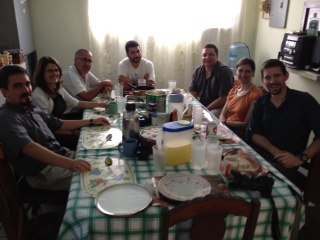
We had a savory Honduran breakfast in the hotel restaurant, seated in front of the graffiti wall with last night's wall art conspicuously visible.

Today, we are meeting the Ministry of Health and then head up the mountain to La Hicaca, for an overnight planning trip.

We will be out of mobile service and without electricity and sanitation tonight. Back to nature.

Check tomorrow for a thorough summary of the day's events.

Monday, January 14, 2013

Honduras Day 2: January 14, 2013


I awoke at 4:45 AM, partly rested yet ready to go after a night of rest at la Quinta Hotel. 

Breakfast was at Dunkin Donuts, where a tall coffee was in order. A book of ‘quejas’ or complaints, was in plain view at the Dunkin Donuts cash register. The entries in the complaint book provided some entertaining reading.

The three hour drive to Olanchito was smooth and efficient. We arrived in record time and checked into our relatively luxurious accommodations at the Hotel Beverly.

By noon we met with our collaborators, Father Pedro O’Hagan and his colleagues of the Olanchito Catholic diocese for a working lunch to discuss the upcoming May 2013 medical relief trip. The principal topics of discussion were a review of last year's relief effort, the clinical schedule and the expansion of the water filter project.

Tomorrow we are meeting the local Health Minister at 8 AM. Later, we are off to the mountains, to the village of La Hicaca, our medical home base.

Tonight, back at the Hotel Beverly, for a meal and some much needed rest.

More to come tomorrow, stay tuned.

For more information visit the VCU Global Health and Health Disparities website.


Sunday, January 13, 2013

Honduras Day 1: January 13, 2013

Today’s trip was uneventful. 

The flights to San Pedro Sula were on time.

After a short delay at the airport, we picked up our rental Toyota Prado 4x4. The Sunday drive was pleasant through the picturesque Honduran countryside.

Tonight we are in La Ceiba. Tomorrow, Olanchito.

Stay tuned. 


Saturday, January 12, 2013

Letter to the Editor: Nostalgic Professionalism- Professionalism in the era of duty hours: time for a shift change?

Marcus Welby, MD: Nostalgic Professionalism
Drs. Edmond, Wenzel and I wrote a letter to the editor of JAMA last month in response to this article on professionalism in the era of duty hour restrictions.

The letter was not published. This is neither the first nor the last time that one of our submissions has been rejected. No worries. The letter is published below.

To the Editor:
As clinicians trained before the ACGME duty hour restrictions, we have strong concerns about the viewpoint published by Arora et al (1).These authors would argue that we cling to the now antiquated notion of 'nostalgic professionalism,' defined as consistently placing the patient's or the profession's needs above one'sown personal needs (2). 

Nostalgic professional values conflict with the current model of training and Arora and colleagues’newly proposed model of professionalism, which emphasizes the importance of physicians' health and work-life balance. They argue for residency training that fully adopts a team-based model of patient care, one in which patient ownership is not delegated to a single resident physician, but shared among a group of team members. The authors have no data that such a shift in practice will be acceptable to patients or make the quality of care better. Our experience suggests the opposite is likely: patients want more not less time with their physicians, and we think that an in-depth history and physical examination and ongoing follow-up bring a physician and patient close together.This cannot be achieved with shift-work teams. Moreover, the rigor and quality of medical education may be affected as there is no substitute for direct patient care when learning the practice and art of medicine.


We fail to be convinced that all members of a medical team will fully know the details of the patient’s history and clinical course without experiencing a complete doctor-patient encounter. Through a careful history and physical examination, the doctor-patient relationship is established(3)and further enhanced by daily follow-up. Anything short of this rigor will erode the quality of that relationship, and negatively impact patient ownership and the physician’s individual sense of professional responsibility.As subspecialist consultants in the current era of multiple hand offs of patient care, we routinely experience the downsides of interacting with clinicians who know the patient less well because they have only dealt with a limited segment of the patient’s inpatient course. 


In our view, the patient will always come first. It is a duty that lies at the core of humanism, which opposes any compromise of professionalism.

References:
1.    Arora VM, Farnan JM, Humphrey HJ. Professionalism in the era of duty hours: time for a shift change?JAMA. 2012;308(21):2195-6
2.    Hafferty FW, Levinson D. Moving beyond nostalgia and motives: towards a complexity science view of medical professionalism. PerspectBiol Med. 2008;51(4):599-615
3.    Verghese A, Brady E, Kapur CC, Horwitz RI. The bedside evaluation: ritual and reason. Ann Intern Med. 2011;155(8):550-3

Friday, January 11, 2013

Compliance With Central Venous Catheter Dressings- How are We Doing?

We are well aware of central line insertion checklists for the placement of central venous catheters (CVC). Following CVC insertion, proper maintenance is important to minimize the risk of a CVC associated bloodstream infection. How well do we abide by evidence based catheter maintenance standards? Per an article published in the American Journal of Infection Control, there is room for improvement.

The study evaluated a total of 420 CVC sites and found deficiencies in 31%. Internal jugular CVC dressings were the most frequently deficient type (P = 0.001). No correlation between CVC site maintenance and central line–associated bloodstream infections was detected (Spearman's correlation coefficient = 0.007; P = 0.98).

The most common suboptimal CVC dressing conditions were blood under the dressing, marked dressing edge lift or exposed catheter and visible moisture under the dressing.

We should not be surprised that compliance with catheter site maintenance is less than optimal. As with nearly all components of infection prevention and safety, implementation of practice change is a challenge. 

Why should something as simple as appropriately dressing a central venous catheter be any different?

Wednesday, January 9, 2013

HAC NO!- Rap Video on Patient Safety and Hospital Acquired Infections

We are always looking for innovative ways to spread the gospel of hospital infection prevention.

Below is a video that raps about the prevention of hospital acquired conditions (HAC) and a corresponding article in the Syracuse Post-Standard.


Get the word out.

N95 Respirator Masks- Impact on Pulmonary and Heart Rate Responses

For some, wearing a PFR N95 (respirator) mask, used for the care of patients on airborne precautions (TB, Pandemic Influenza), is uncomfortable. What impact does a PFR N95 mask have on physiology? Here is a publication that attempts to specifically answer this question.
Twenty young, healthy subjects exercised on a treadmill at a low-moderate (5.6 km/h) work rate while wearing 4 different models of N95 filtering facepiece respirators for 1 hour each, 2 models of which were equipped with exhalation valves, while being monitored for physiologic variables.
Compared with controls, respirator use was associated with mean 1 hour increases in heart rate (range, 5.7-10.6 beats per minute, P < .001), respiratory rate (range, 1.4-2.4 breaths per minute, P < .05), and transcutaneous carbon dioxide (range, 1.7-3.0 mm Hg, P < .001). No significant differences in oxygen saturation between controls and respirators were noted (P > .05).
These physiologic changes are statistically significant yet relatively small. As such, they may not be concerning from a clinical perspective. In other words, the use of a N95 mask should not have any deleterious health impact on a HCWs without cardiopulmonary disease who wear them for periods of less than an hour. 

Fortunately, the majority of HCWs are in the clear on the above criteria.